Fail-Proofing Mechanisms for Wheeled Robots
Year 1 of VEX Robotics
Project at a glance
- Developed intake and launching mechanisms for two VEX U competition robots.
- Improved the six-wheel intake to greater than 95% success through friction and tension tuning.
- Collaborated with a design team of more than 10 students and qualified for the World Championship.
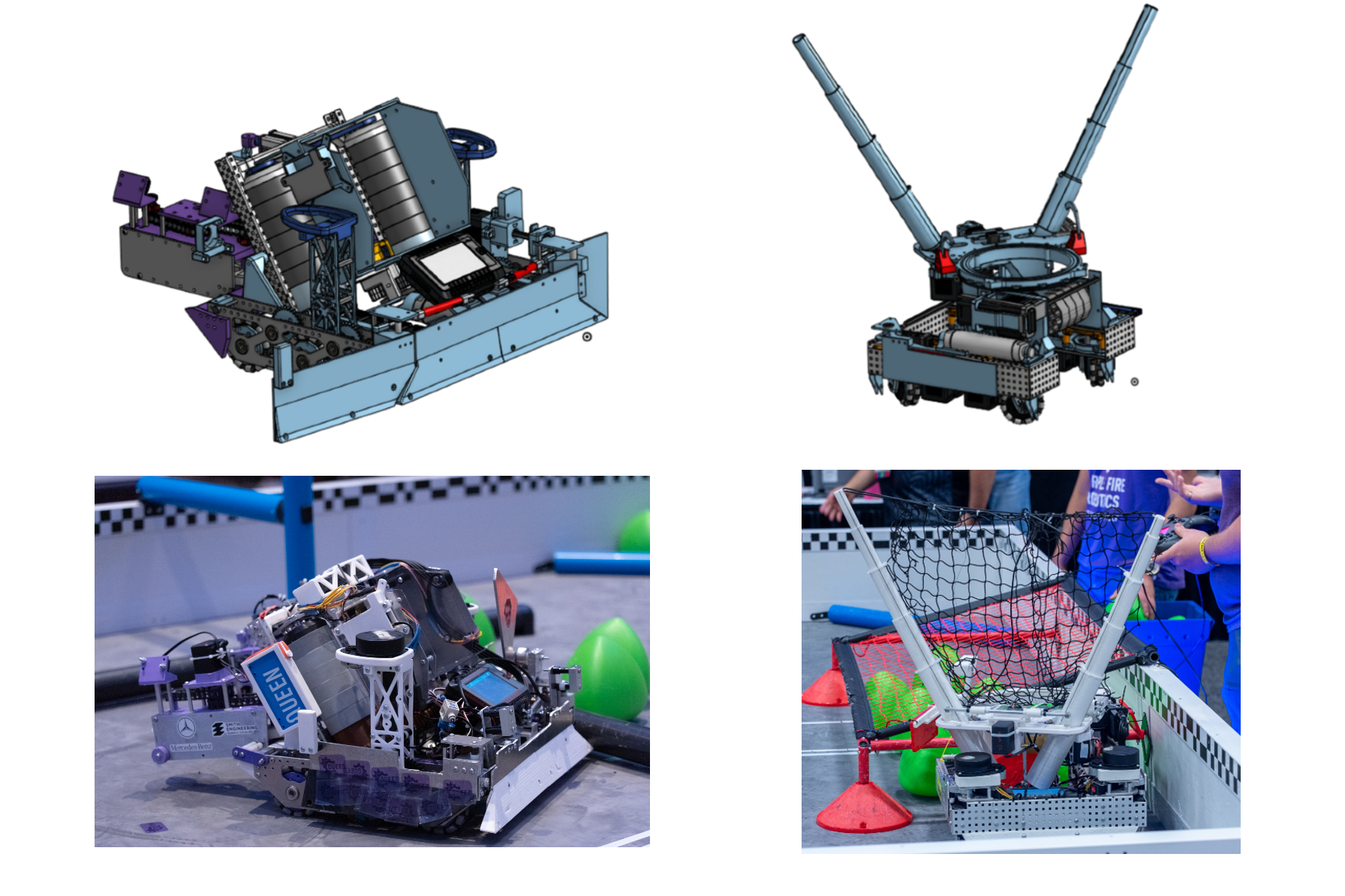 24" Worlds Robot (left), 15" Worlds Robot (right)
I joined QVEX during my second year at Queen’s. We build competitive wheeled robots that can launch and catch projectiles, climb structures, and complete other game-specific tasks, sometimes autonomously. As part of the mechanical design team, I helped develop reliable projectile-intake and launching mechanisms that qualified us for the VEX U World Championship in Dallas.
Experience, Learning & Skills
24" Worlds Robot (left), 15" Worlds Robot (right)
Experience & Skills
-
Collaborated with more than 10 engineering students using Onshape, SolidWorks, and SolidWorks Simulation to design, prototype, manufacture, and assemble four wheeled robots in eight months.
-
Experimented with rack-and-pinion systems, slip gears, and chain-and-sprocket drives.
-
Developed skills in technical communication, design reviews, and explaining the trade-offs behind a proposed strategy.
Learning
-
Integration is hard: Designing an entire CAD system alone is straightforward because one person understands how every subsystem should fit. Team-based CAD is harder because each designer starts with different assumptions. Staying organized and documenting interfaces is essential for a coherent final assembly.
-
A design is not finished until it is tested: We ran out of time to validate every mechanism before the World Championship, and the robots performed poorly as a result. We relied too much on what I call “hopium”: optimism that ignores Murphy’s Law and assumes untested systems will work in competition.
-
Beware the sunk-cost bias: We developed several mechanisms that were strategically inferior for the game but remained committed because of the time already invested. Re-evaluating decisions throughout the design process helps keep the final strategy grounded in performance rather than effort spent.
Motivation
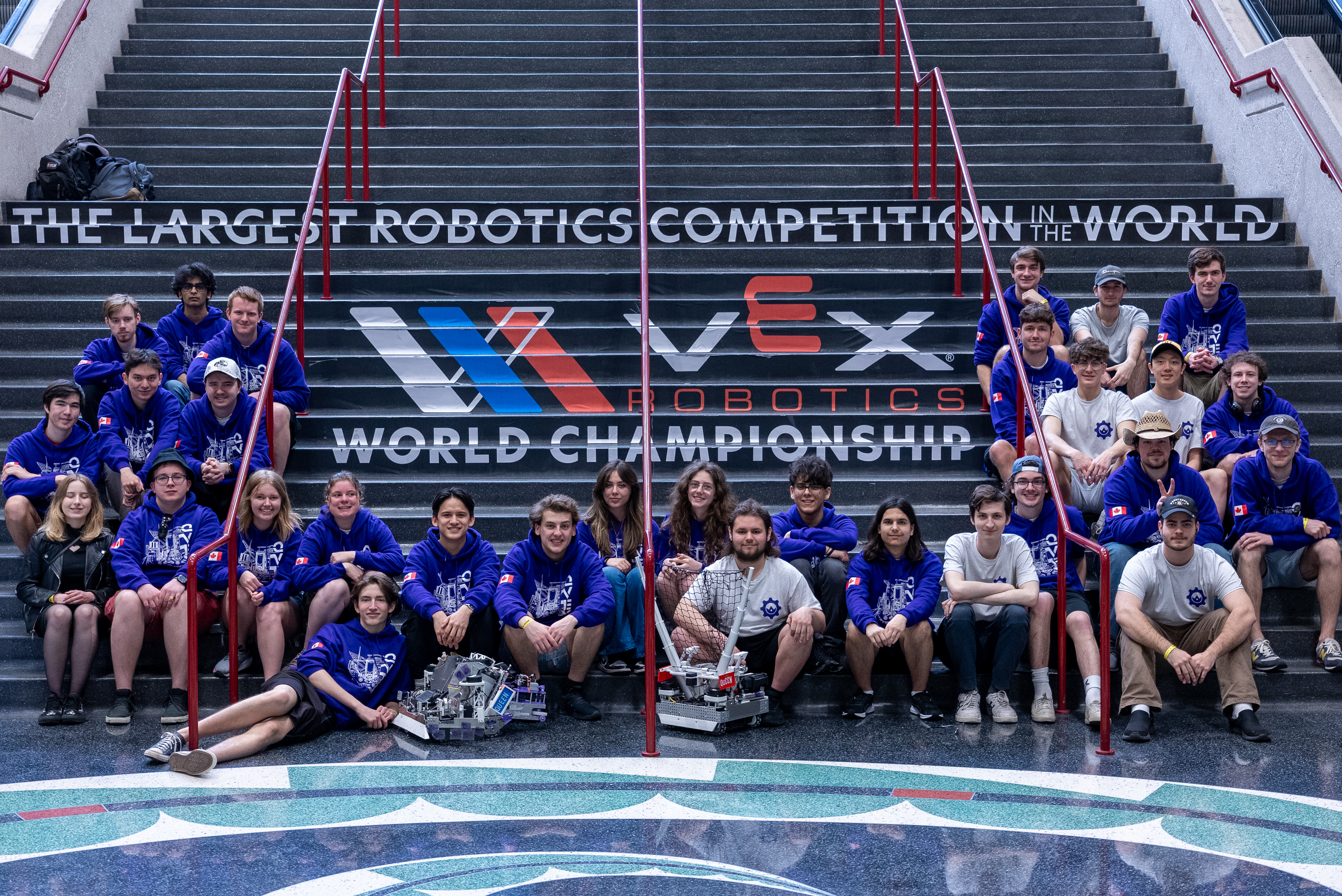
I joined QVEX for the engineering experience and the people. The team taught me about collaborative design, project management, mechanical development, and novel mechanisms while connecting me with talented people who enjoy building robots.
Technical Details
VEX introduces a new game every year. The 2023–2024 game, Over Under, awarded points for moving green Reuleaux-tetrahedron game pieces under a net. Our strategy was to launch the pieces from one robot to the other and then fire them under the net—essentially an alley-oop between robots.
Here is what I mean
We built a 15-inch robot and a 24-inch robot. Many of the systems shown here were designed by other team members. Everyone involved—not only the mechanical team—deserves credit: Patrick, Michael, James, Theo, Cole, Maxim, Avery, Peter, Ryan, Nikola, Koen, Cass, Laura, Taylor, Xan, Becca, Ben, Liam, Cal, Callum, Evan, Kieran, Mike, Nick, and everyone else I missed.
The 15-inch robot used a 3D-printed differential-swerve drivetrain and a rotating, cascading net.
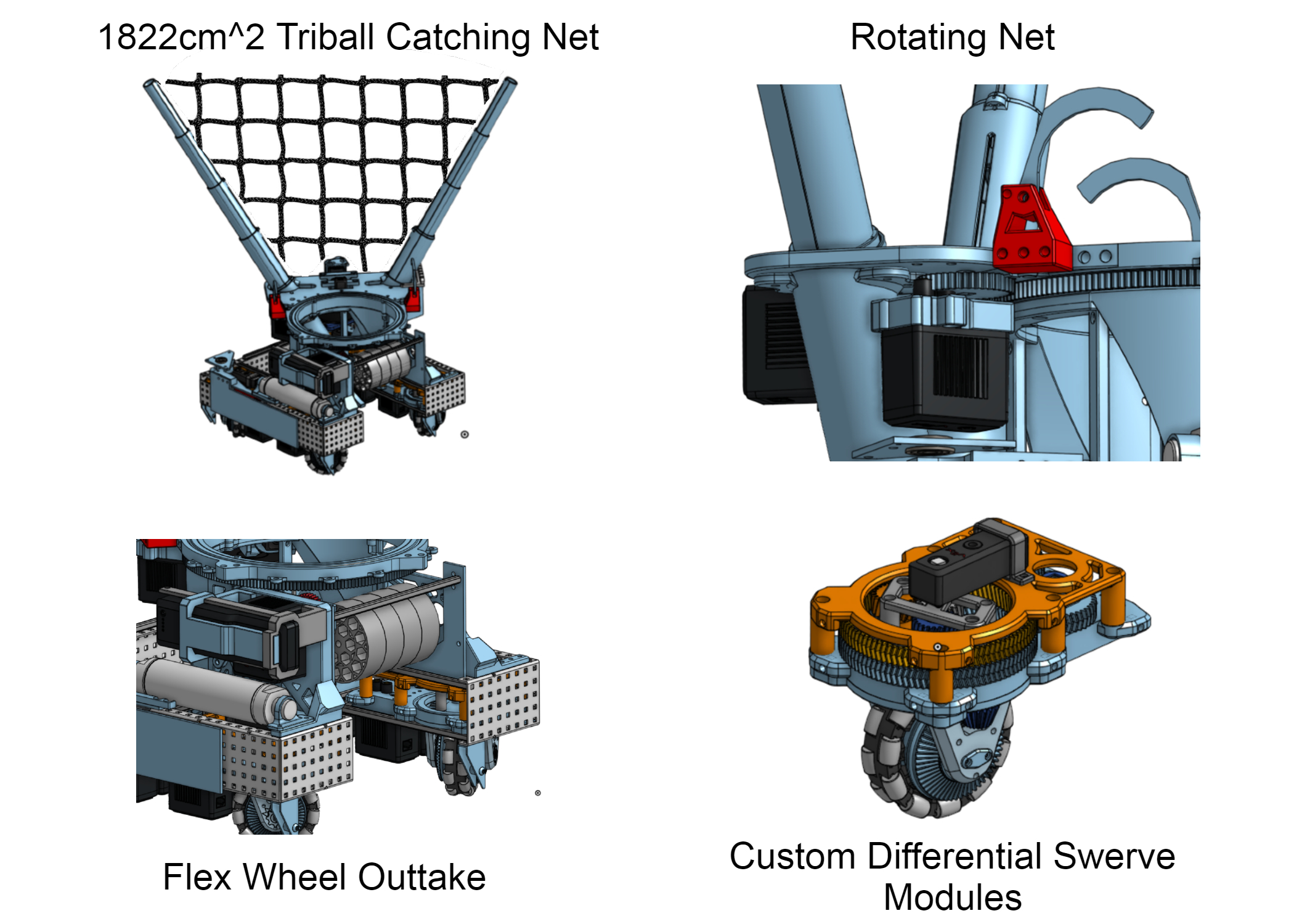
The 24-inch robot used a more conventional tank drivetrain and weighed almost 40 lb. It was designed for defence and pushing opposing robots.
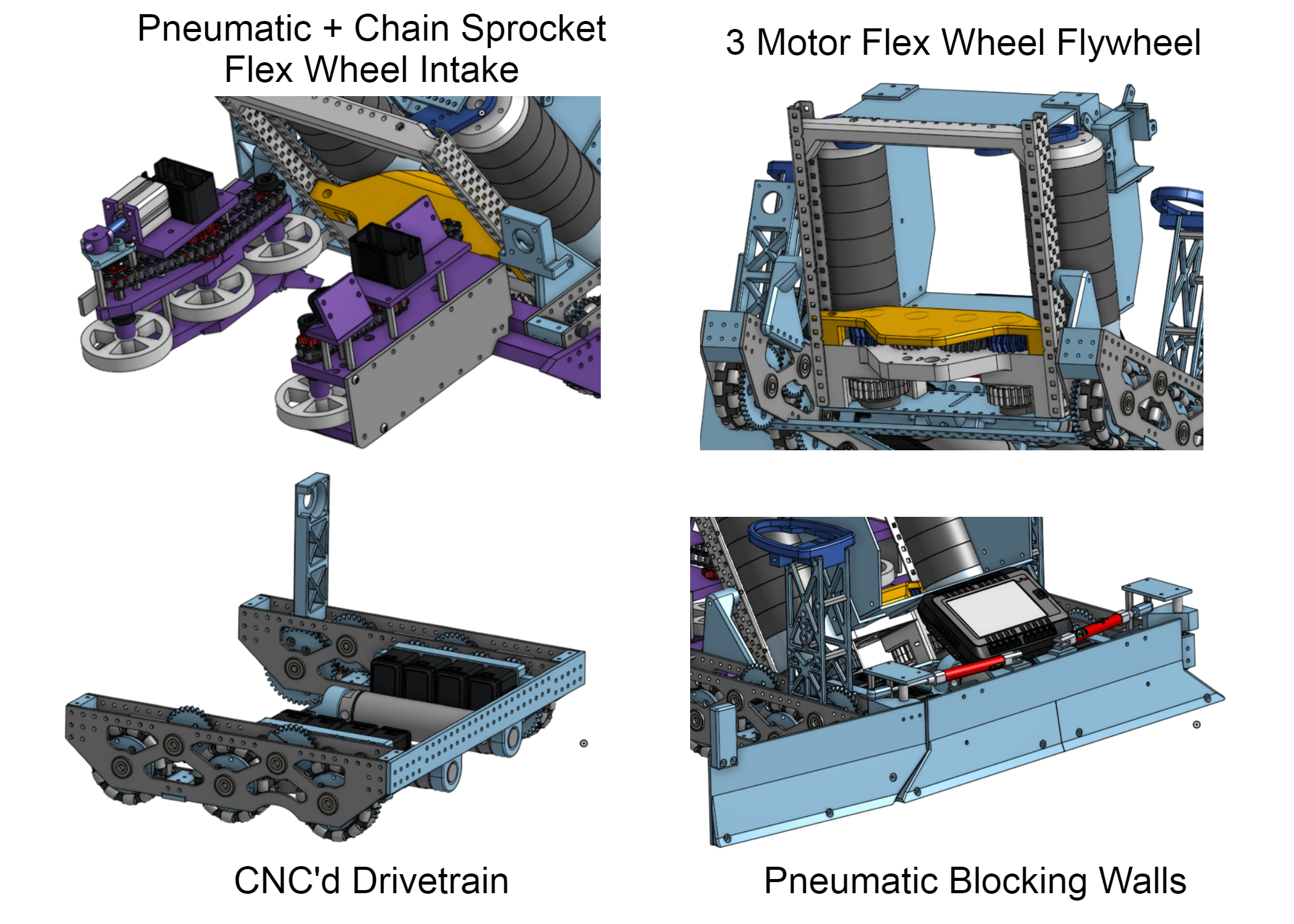
Intakes
What and How
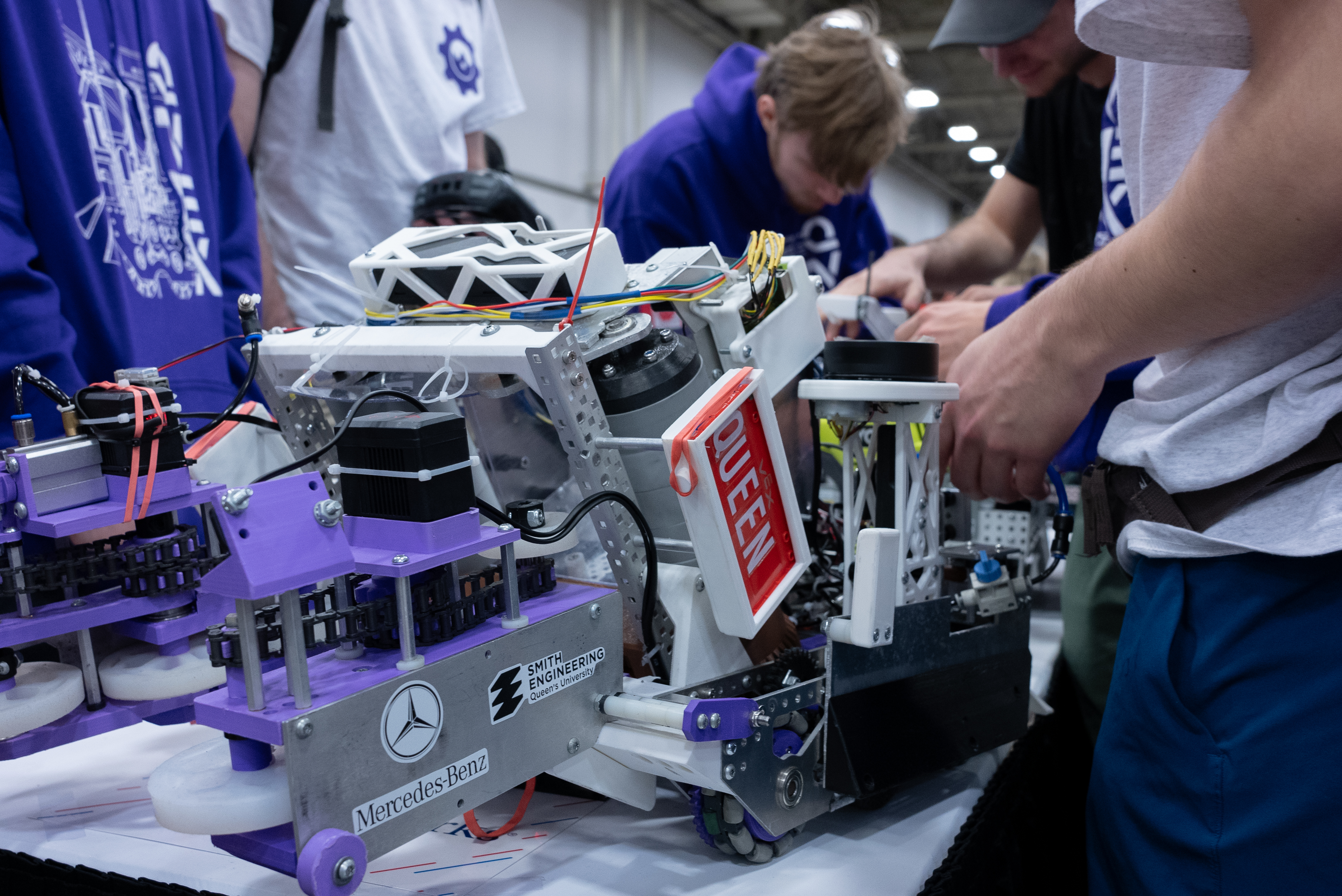
Our strategy required launching triballs—the green Reuleaux tetrahedrons—from a loading zone across the field to the other robot. I designed a six-wheel flex-wheel intake driven by chains and sprockets to move the game pieces reliably from the loading zone into the flywheel launcher.
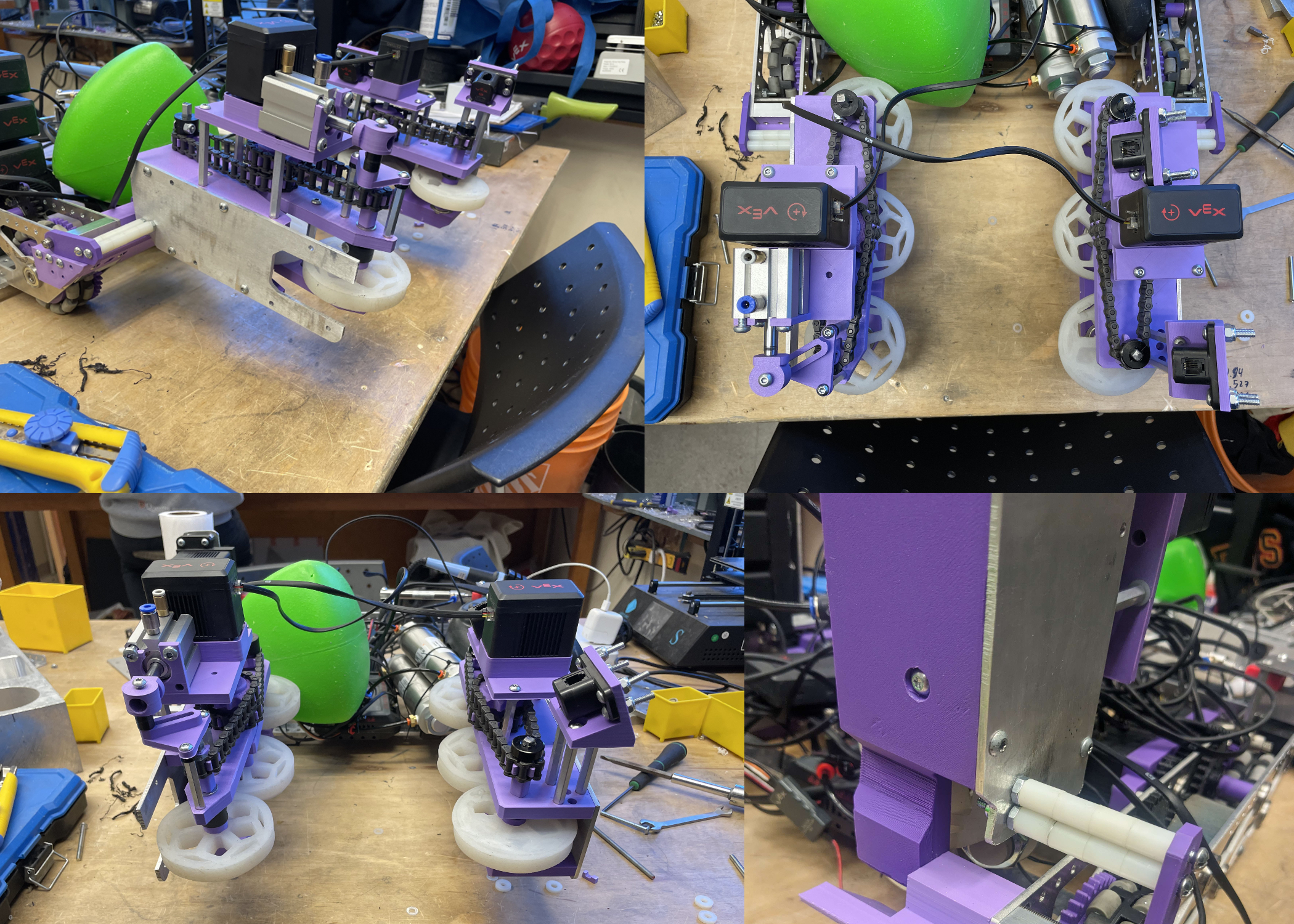 The final design
The video below explains the intake features and their purpose.
Issues, Solutions and Optimizations
We resolved several technical issues before achieving a success rate above 95%:
- Friction: VEX motors have limited power and overheat under sustained load. A low reduction ratio produced the required intake speed but reduced available torque, making the system susceptible to stalling. Proper bearing alignment and lower shaft-normal forces reduced friction enough for reliable operation.
System Testing